Video Sewer Inspection in Trenton, NJ
A video sewer inspection, also called a sewer camera inspection, pushes a small waterproof camera through a sewer line on a flexible cable and shows what is inside the pipe on a screen above ground. It is the step that turns a guess about a drain problem into something that can be seen: the blockage, the pipe material, the cracks, the roots, the sag, and the exact distance to the problem. This page explains what an inspection shows, when to get one, and what the report should contain.
Drain and sewer assistance for homes, rentals, and local properties in Trenton, NJ.
Calls may be routed to an independent local service provider.
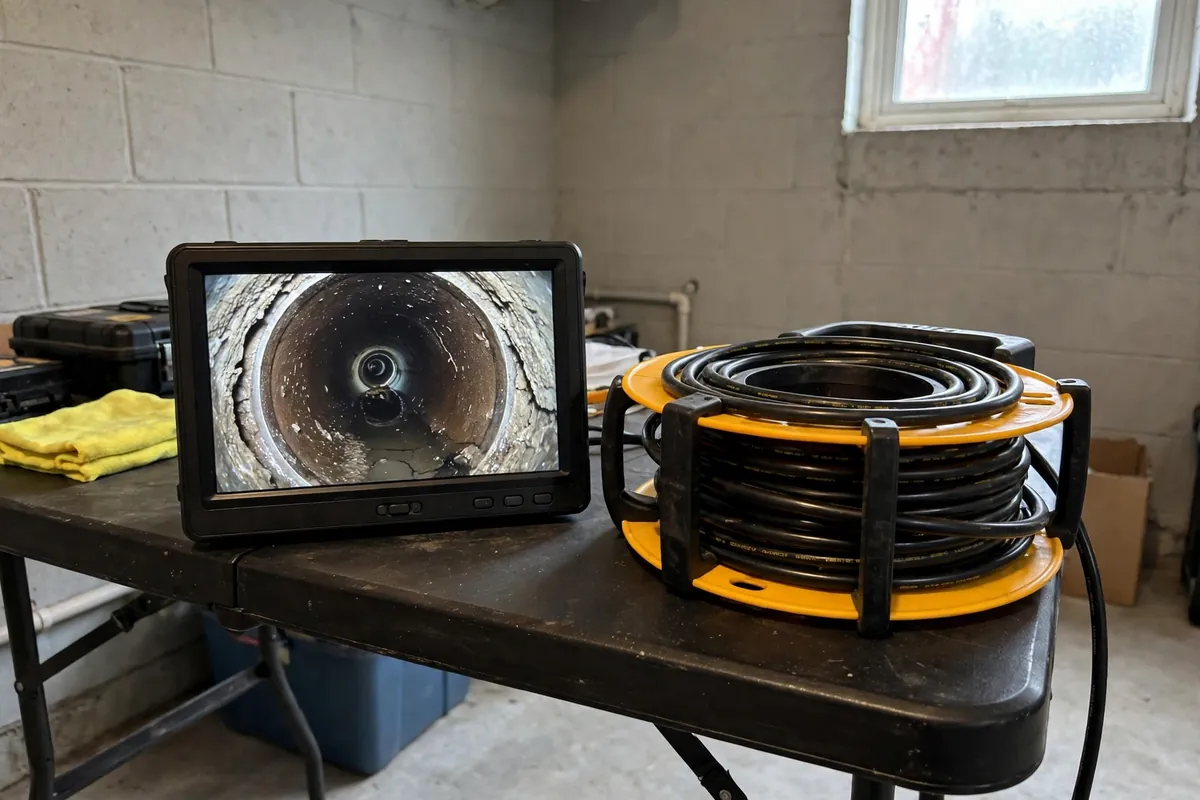
A sewer camera inspection monitor showing the inside of a pipe.
Key Takeaways
- A video sewer inspection shows the inside of the sewer line, so the cause of a drain problem can be seen rather than guessed.
- It shows the blockage, the pipe material, cracks, collapses, bellies, offset joints and root entries, with the distance to each one.
- A camera inspection is the right step when a drain keeps clogging, when several fixtures are affected, or before buying an older home.
- A general home inspection does not usually cover a buried sewer lateral. A camera inspection is the only way to know its condition.
- The inspection report, with distances and a recording, is worth keeping with the house papers.
- A camera diagnoses. It does not clean or repair on its own, but it decides which cleaning or repair is right.
What a Video Sewer Inspection Is
A video sewer inspection uses a small waterproof camera, mounted on the end of a flexible cable, that is pushed through a sewer line from a cleanout or a fixture. The camera sends live video to a screen above ground, so the operator can see the inside of the pipe as the camera moves through it, and the inspection is usually recorded. A locator, a device that picks up a signal from the camera head, is often used at the same time, so the position of the camera underground can be marked on the surface, with the depth of the line and the distance from the cleanout. Together, the video and the locator give a complete picture: what is wrong, what the pipe is made of, and exactly where the problem sits.
The camera itself is a simple instrument with a clear purpose. It has a light, so the inside of a dark pipe can be seen, and it is small enough to pass through a residential sewer lateral, usually four inches in diameter, though the exact size varies by house. The cable is marked in feet, so the distance to anything seen on screen can be read off directly. The operator moves the camera slowly, stopping at anything that looks wrong, and the recording captures the whole run, from the cleanout to the public main or as far as the camera can go. If the camera cannot pass a certain point, that itself is information: it usually means a collapse, a severe offset, or a blockage that is too dense to push through.
An inspection is not a repair, and it is worth being clear about that. The camera shows the problem, but it does not fix it. What it does is make the fix possible to plan: a root mat at twenty feet is a different job from a collapsed pipe at forty feet, and a cracked clay lateral is a different job from a scaled cast-iron line. Without a camera, a provider is guessing from the symptoms at the surface, and a guess can mean clearing a line that needed lining, or lining a line that needed bursting. With a camera, the discussion is about what was seen, and the homeowner can see it too, on the recording, rather than taking a description on trust.
In Trenton, a camera inspection is especially useful because of the age of the housing. About 74% of Trenton homes were built before 1960, according to American Community Survey data reported in 2023, and the laterals under those homes are often as old as the houses themselves. A lateral that has never been inspected may be clay, cast iron or Orangeburg, and each of those materials fails in its own way. The only way to know which material is under a particular home, and what condition it is in, is to look inside it with a camera. The year the house was built is a clue, but it is not proof: lines are patched and partly replaced over decades, so one lateral can contain two or three materials, and only a camera can show the mix.
What a Sewer Camera Shows
| What the camera shows | What it means | What usually follows |
|---|---|---|
| A root mat growing through a joint | Roots have entered through a joint or crack and are catching debris. | Root cutting, then a discussion of lining or repair. |
| A crack in the pipe wall | The pipe is damaged and letting soil and roots in. | A spot repair or a lining, depending on how many cracks there are. |
| A collapsed section | The pipe has lost its shape and the opening is closed. | Pipe bursting or open excavation and replacement. |
| Water sitting in a low section | A belly, a sag where water and solids settle instead of flowing. | Regular cleaning for a shallow belly; re-laying for a deep one. |
| An offset joint | One section of pipe has shifted relative to the next, creating a lip. | A spot repair or a lining, depending on the extent. |
| Scale and corrosion inside cast iron | The pipe is narrowing from the inside as it corrodes. | Descaling by jetting, if the pipe is thick enough, or replacement. |
| Orangeburg pipe, soft and deformed | A fibre pipe that has lost its round shape under soil load. | Replacement or lining, because the pipe is past its serviceable life. |
| A clean pipe in good condition | The line is sound and the problem is material inside it. | Cleaning, and a discussion of the habits that caused the blockage. |
When to Get a Video Sewer Inspection
The most common reason to get an inspection is a drain problem that keeps returning. A drain that clogs every few weeks, a main line that needs cleaning every few months, or several fixtures that slow at once are all signs that the pipe itself has a problem, and a camera is the way to see what that problem is. Clearing the line again without looking inside it is guessing, and the guess gets more expensive each time, because the cleaning has to be repeated and the underlying damage gets worse in the meantime. A camera inspection after the second or third recurrence is usually the point where the cost of looking is less than the cost of another round of cleaning that does not last.
The second reason is a repair or replacement decision. No repair should be planned without a camera inspection, because the repair has to fit the damage, and the damage cannot be known from the surface. A lining needs a pipe that still holds its shape. Pipe bursting needs a clear path. A spot repair needs to know exactly where the damage is and how deep it lies. A camera inspection gives all of that, with distances and depths, so the repair can be planned and the surface above the line can be disturbed as little as possible. A provider who recommends a repair without a camera inspection is asking a homeowner to agree to work whose scope has not been established.
The third reason is buying a home. A general home inspection does not usually cover a buried sewer lateral, because the inspector cannot see underground, and the standards that govern home inspections specifically exclude buried sewer lines. That means a buyer can purchase a home with a cracked, root-damaged or collapsed lateral and discover it only when the drains back up a few weeks after moving in. A camera inspection before purchase shows the material and condition of the lateral, and it gives the buyer information that can be discussed before the sale is completed. In Trenton, where most homes are several decades old, that check is especially worth doing, and it is a small step compared with the cost of a sewer line replacement discovered after purchase.
There are other times an inspection is worth doing. Before a major renovation that adds a bathroom or changes the drainage, an inspection shows whether the existing line can handle the extra load. After a backup that involved sewage, an inspection shows whether the line is damaged or was simply blocked. When a home is being sold, an inspection can give the seller a clear report to share with buyers, which avoids a dispute later. And when a neighbour's line has failed, an inspection can show whether the same problem is developing in a line of the same age and material on the same street. In each case, the inspection is a small investment in knowing what is underground, rather than discovering it at the worst possible time.
What Happens During an Inspection
Locate the cleanout
The professional finds the cleanout, the capped access pipe that gives direct entry to the sewer lateral. If there is no cleanout, the camera may be run through a fixture, or a cleanout may need to be installed first.
Run the camera through the line
The camera is pushed through the line on its cable, slowly, from the cleanout toward the public main. The operator watches the live video and stops at anything that looks wrong, and the whole run is recorded.
Locate problems from the surface
A locator picks up the signal from the camera head, so the position of each problem can be marked on the surface, with the depth of the line and the distance from the cleanout.
Discuss the findings
The professional talks through what the camera showed, what it means for the line, and what the choices are: cleaning, repair, lining, bursting or replacement. The recording and the report are kept for the homeowner's records.
What a Good Inspection Report Should Contain
A good inspection report is a record that anyone can use later, not just a verbal summary. It should include the recording of the camera run, so the homeowner can see what was seen and a future provider can watch the same run. It should list the pipe material, or the mix of materials if the line has been patched, because the material decides the repair choices. It should give the distance from the cleanout to each problem, in feet, and the depth of the line at each problem, so the location can be found again without another inspection. And it should describe each problem plainly: a root mat at twenty feet, a crack at thirty-five feet, a belly at fifty feet, with the severity of each one noted.
The report should also say what was not seen. If the camera could not pass a certain point, the report should say where it stopped and why, because that is itself a finding, and it usually means a collapse or a severe offset at that point. If the line was not cleaned before the inspection, the report should say so, because a dirty pipe can hide cracks and joints, and the findings may need to be confirmed after cleaning. If a lateral connection was found, the report should note it, because a connection that is not reopened after a lining will block a branch line. A report that leaves these things out is incomplete, and a homeowner who receives one should ask for the missing detail.
Keep the report with the house papers. A sewer line is an asset of the property, and its condition is a fact about the property that a future buyer, a future plumber, or the municipality will want to know. A report from a camera inspection, with distances and a recording, answers the next question anyone asks about that line, and it avoids paying for another inspection to establish facts that were already established. If a repair is done, keep the report from after the repair as well, so the record shows the line before and after the work, and the next person who looks at the line can see what was done.
Video Inspection in Trenton's Older Homes
Trenton's housing makes a camera inspection more useful than in a newer city, because the laterals are older and the materials are more varied. A home built before 1945 is likely to have a clay or cast-iron lateral. A home built from the 1940s into the early 1970s may have Orangeburg pipe, a fibre pipe made from wood pulp and pitch that softens and deforms as it ages. A home built from the late 1970s onward is increasingly likely to have plastic pipe. But those are rules of thumb, not certainties: lines are patched and partly replaced over decades, so one lateral can contain clay near the street, cast iron near the house, and a section of plastic from a repair done in the 1980s. Only a camera can show the mix, and the mix decides the repair.
The combined sewer system in Trenton's older sections is another reason an inspection is useful. The city is one of 21 New Jersey municipalities in the New Jersey Department of Environmental Protection's Combined Sewer Overflow program, which means that in older sections the same pipes carry both wastewater and stormwater. A camera inspection can show whether a lateral connects to a combined system or a separate one, and whether stormwater is entering the lateral through a crack or a broken connection. That matters for a backup that happens only when it rains, because the answer is different from a backup caused by a blockage in the house, and the inspection is the step that separates the two.
For a buyer, the inspection is also a way to learn about the house itself. A lateral in good condition is a sign that the underground work has been maintained. A lateral with roots entering through many joints is a sign that the line is near the end of its life, and that a lining or replacement should be discussed before purchase. A lateral that has already been lined or replaced is a sign that the work has been done, and the report from after the work is worth asking for. In each case, the camera gives the buyer information that the house itself cannot give, because the line is underground and out of sight.
Call for a Video Sewer Inspection in Trenton
A drain that keeps clogging, or a home purchase in Trenton where the sewer line has never been checked? Call now to describe the situation and connect with an independent local drain professional who can discuss a video sewer inspection.
Trenton Drain Pros is a referral service connecting callers with an independent local service provider; the provider is responsible for diagnosis, pricing, scheduling, licensing and the work performed.
Frequently Asked Questions
What is a video sewer inspection?
A video sewer inspection pushes a small waterproof camera through a sewer line on a flexible cable and shows what is inside the pipe on a screen above ground. It shows the blockage, the pipe material, cracks, collapses, bellies, offset joints and root entries, with the distance to each one. The inspection is usually recorded, and a locator is used to mark the position and depth of each problem on the surface.
How much does a sewer camera inspection involve for the homeowner?
The inspection is done through a cleanout or a fixture, so there is usually no digging and no disruption inside the home. The professional runs the camera through the line, records the run, and talks through the findings. The homeowner does not need to prepare anything, though knowing where the cleanout is, and whether the line has been inspected before, is helpful.
Can a camera inspection find tree roots?
Yes. Roots show clearly on camera as a fibrous mat growing through a joint or a crack, and the camera shows how far along the line the roots affect and how dense the mat is. That information decides whether root cutting is enough, or whether the pipe needs lining or replacement to stop the roots returning.
Will a camera inspection damage my sewer line?
No. The camera is a small, smooth instrument that is pushed gently through the pipe on a flexible cable. It does not cut, scrape or apply pressure to the pipe walls. If the camera cannot pass a certain point, that is because the pipe is already blocked or damaged at that point, not because the camera caused the damage.
What if the camera cannot get through my sewer line?
If the camera stops at a certain point, that is itself a finding. It usually means a collapse, a severe offset joint, or a blockage too dense to push through. The distance to that point is recorded, and the professional can discuss the next step, which is usually to clear the blockage with a cable machine and run the camera again, or to plan a repair at the location where the camera stopped.
Should I have a sewer inspection before buying a home?
A camera inspection before purchase is a sensible step, especially for an older Trenton home. A general home inspection usually leaves a buried lateral out of scope, so the camera is the only way to see the pipe material and condition before the sale is completed. It can show roots, cracks, sags and collapsed sections that would otherwise surface only after a backup.
How long does a video sewer inspection take?
That depends on the length of the line and whether the line needs cleaning first. A straightforward inspection of a residential lateral is usually a short visit. If the line is blocked and needs to be cleared before the camera can pass, or if several problems need to be located from the surface, the visit takes longer. The local professional can discuss timing when you describe the situation.
What should I do with the inspection report?
Keep it with the house papers, along with the recording. It is a record of the condition of the sewer line, with distances and depths, that a future buyer, a future plumber or the municipality may want to see. If a repair is done, keep the report from after the repair as well, so the record shows the line before and after the work.
Need Drain Cleaning Help? Call Now
Describe the drain problem and discuss the help available for your specific situation.