Hydro Jetting in Trenton, NJ
Hydro jetting cleans a drain or sewer pipe with high-pressure water, scouring grease, scale and debris from the inside walls of the pipe along its full length. It is the difference between opening a path through a blockage and actually cleaning the pipe, and for grease and scale buildup it is the tool that a cable machine cannot replace. This page explains how hydro jetting works, when it is the right choice, when it is not, and what happens during a visit in Trenton.
Drain and sewer assistance for homes, rentals, and local properties in Trenton, NJ.
Calls may be routed to an independent local service provider.
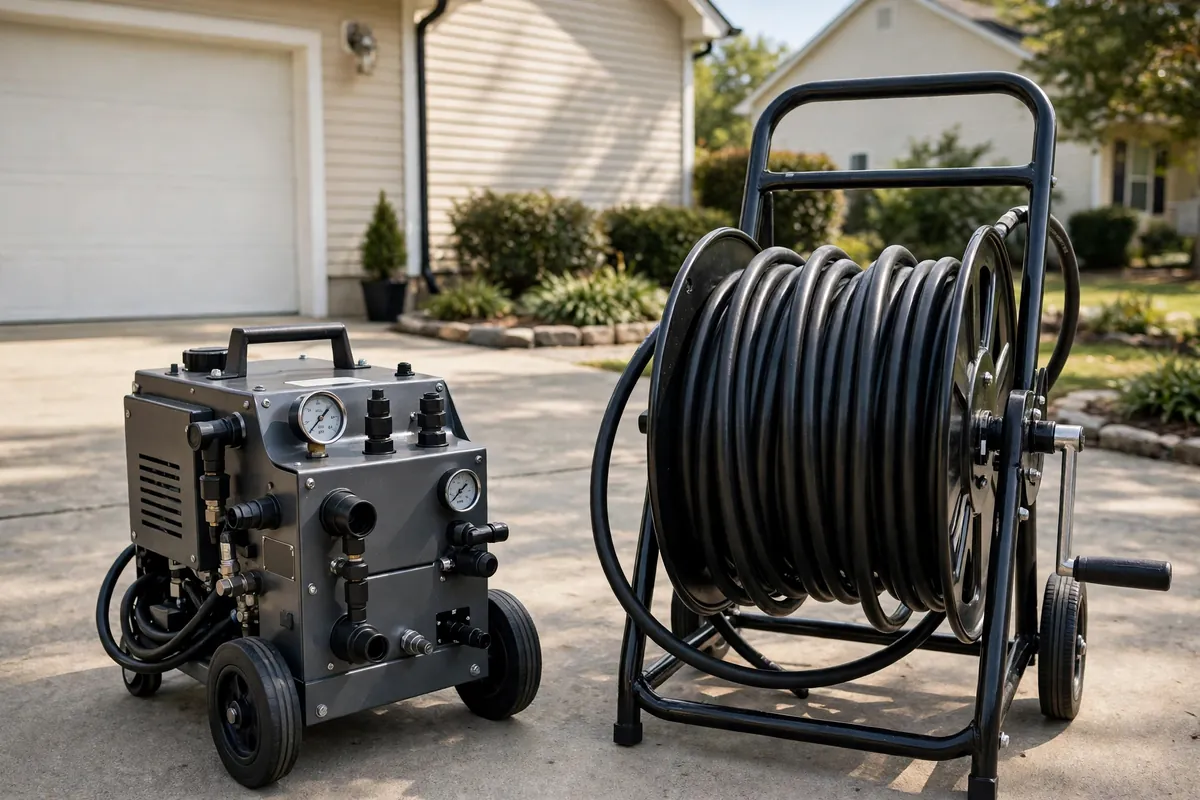
Hydro jetting equipment with a coiled high-pressure hose.
Key Takeaways
- Hydro jetting uses high-pressure water to scour the inside walls of a pipe clean along its length.
- It is the right tool for grease, scale and heavy buildup that a cable machine only pokes a hole through.
- Snaking breaks through a blockage. Jetting cleans the pipe. A camera inspection helps decide which one is needed.
- Jetting should not be used on a pipe that is already collapsed or badly cracked. A camera check comes first when damage is suspected.
- Jetting is often used after root cutting, to wash the cut material and the buildup behind it out of the line.
- A jetted line usually stays open longer than a line that was only snaked, because the pipe walls are clean.
What Hydro Jetting Is
Hydro jetting is a drain cleaning method that uses a hose with a specially designed nozzle, fed into the pipe through a cleanout or a fixture, to spray water at high pressure in all directions. The nozzle has jets that point backwards as well as forwards: the forward jets break up the blockage, and the backward jets pull the hose through the pipe and scour the walls as it moves. The water pressure is set to suit the pipe: high enough to strip grease and scale from the walls, but not so high that it damages a sound pipe. The debris that is loosened is flushed downstream and out of the line, and the pipe is left close to its original diameter.
The difference from snaking is the difference between clearing and cleaning. A cable machine uses a rotating cable with a cutting head to break through a blockage, which opens a hole for water to pass. That is enough for a solid blockage or a root mat, and it is the right first step when a line is completely blocked. But a cable only touches the blockage itself. The grease coating the walls, the scale narrowing the pipe, and the debris settled along the length of the line are all still there after the cable is pulled out, and the drain will clog again quickly. Hydro jetting touches the whole inside surface of the pipe, which is why a jetted line usually stays open longer than a line that was only snaked.
Hydro jetting is not a new idea, and it is not a delicate one. It is used on residential drains, on main sewer lines, on commercial kitchen lines, and on municipal sewers, with the pressure and the nozzle chosen for the size of the pipe and the material blocking it. A small nozzle and lower pressure suit a kitchen drain. A larger nozzle and higher pressure suit a main sewer line with heavy grease. A root-cutting nozzle, with a spinning head, is used after roots have been cut with a cable, to wash the cut material out. The choice of nozzle and pressure is part of the professional assessment, and it depends on what the camera shows inside the pipe.
There are limits, and they matter. Hydro jetting should not be used on a pipe that is already collapsed, badly cracked, or so weakened by corrosion that high-pressure water could make the damage worse. That is why a camera inspection usually comes before jetting when the pipe is old, when the problem keeps returning, or when a repair is being considered. The camera shows whether the pipe is sound enough to jet, and it shows what is actually blocking it, so the pressure and the nozzle can be set correctly. Jetting a pipe that should have been repaired first is a waste of the visit, and jetting a collapsed pipe can turn a repair into a replacement.
Hydro Jetting Compared With Snaking
| Factor | Snaking (cable machine) | Hydro jetting |
|---|---|---|
| What it does | Breaks through a blockage and cuts roots with a rotating cable. | Scours the inside walls of the pipe with high-pressure water. |
| Best for | Solid blockages, root mats, and opening a line that is completely blocked. | Grease, scale, heavy buildup, and cleaning a line after roots are cut. |
| How long the result lasts | Often weeks to months, because buildup on the walls remains. | Usually longer, because the pipe walls are clean. |
| Reach | Long reach through a cleanout, good for main lines. | Long reach, and it cleans the full length of the pipe it passes through. |
| When not to use it | When the blockage is grease or scale that needs scouring, not cutting. | When the pipe is collapsed, badly cracked, or too weak to take the pressure. |
| Camera needed first | Helpful when the problem returns, but not always needed for a first clog. | Recommended when the pipe is old or damaged, so the pressure is set safely. |
Problems Hydro Jetting Solves Best
Grease is the problem hydro jetting was made for. Cooking fat poured down a kitchen sink cools and hardens on the pipe walls, layer by layer, until the opening is a fraction of its original size. A cable can poke a hole through the grease, but the grease on the walls is still there, and the drain clogs again within weeks. High-pressure water strips the grease from the walls and flushes it out of the line, restoring the pipe close to its full diameter. That is why a kitchen drain that has been snaked several times and keeps clogging is often a jetting job, not another snaking job, and why a restaurant kitchen line, which sees far more grease than a home kitchen, is usually jetted on a planned routine rather than cleared when it blocks.
Scale is the second problem jetting solves well. In older cast-iron pipe, mineral deposits and corrosion build up a rough, crusty layer inside the pipe that narrows the opening and catches debris. A cable can break through the scale at the point of the blockage, but it cannot smooth the walls along the length of the pipe. Jetting scours the scale away, and the pipe flows better along its whole length. There is a caution here: descaling an old cast-iron line also thins a pipe that is already weakened, so a camera inspection should come first to confirm the pipe is thick enough to jet safely. If the pipe is too thin, the answer is repair or replacement, not cleaning.
Heavy debris and settled solids are the third problem. A main sewer line with a low section, a belly, collects water and solids that settle instead of flowing, and the settled material builds into a blockage. A line that has had soil enter through a crack collects the same kind of debris. Jetting flushes the settled material out of the line, and a camera run afterwards shows whether the belly or the crack is still there, which decides whether the line needs repair. Jetting is also used after root cutting: the cable cuts the root mat, and the jetter washes the cut roots and the buildup behind them out of the line, so the pipe is clean rather than just open.
Jetting is also the right tool for a line that has been cleaned before and keeps slowing. If a drain was snaked six months ago and is slow again, the problem is probably buildup on the walls rather than a new blockage, and jetting addresses the buildup directly. The same applies to a commercial drain that serves a kitchen, a laundry or a food business, where the volume of grease, lint or food solids is high enough that a cable clearing never lasts. A planned jetting routine, discussed with the local professional, can keep a commercial line open in a way that emergency callouts cannot.
When Hydro Jetting Should Not Be Used
The main situation where jetting should not be used is a pipe that is already damaged. A collapsed section of pipe has no opening for the hose to pass through, and high-pressure water will not restore it. A badly cracked pipe can be made worse by the pressure, and a cast-iron pipe that has corroded to a thin shell can be breached by a jetter set too high. That is why the camera inspection matters: it shows the condition of the pipe before any water is run through it, and it lets the professional decide whether the pipe is sound enough to jet, whether it needs a lower pressure, or whether it needs repair first. A reputable provider will not jet a pipe they have not seen when the pipe is old or the problem keeps returning.
Jetting is also the wrong first step when a line is completely blocked by a solid object. If a foreign object, a mass of wipes, or a dense root mat is blocking the line entirely, the hose cannot pass through it, and the water has nowhere to go. A cable machine is the right first tool in that situation, to break through the blockage and open a path, and jetting follows once water can flow. The two tools are used together more often than either is used alone: the cable opens the line, the jetter cleans it, and the camera confirms the result. The hydro jetting versus snaking comparison, planned as a dedicated page for the site, covers the choice in more detail.
There are also practical limits. Jetting needs access through a cleanout or a fixture that the hose can pass through, and it needs a water supply and a place for the flushed debris to go. A line with no cleanout and no accessible fixture may need one installed before jetting is practical, which is a small job in itself. A very small drain, such as a bathroom sink trap, is usually cleared with a hand auger rather than a jetter, because the hose is too large for the pipe. The professional who has seen the drain can explain which tool fits, and the answer is usually straightforward once the pipe and the blockage are known.
What Happens During a Hydro Jetting Visit
Assess the line and run a camera if needed
The professional asks which drains are affected, locates the cleanout, and runs a camera through the line when the pipe is old, the problem keeps returning, or a repair is being considered, to confirm the pipe is sound enough to jet.
Open the line first if it is blocked
If the line is completely blocked, a cable machine is used first to break through the blockage and cut any roots, so water can flow and the jetter hose can pass through the pipe.
Jet the line
The jetter hose is fed into the pipe through the cleanout, and high-pressure water scours the walls as the hose moves through the line. The pressure and the nozzle are set for the size of the pipe and the material blocking it.
Flush and check the result
The loosened grease, scale and debris are flushed out of the line, water is run through the fixtures to confirm the drain flows properly, and a camera is run again when the line has a history of problems.
Hydro Jetting in Trenton's Older Homes
Trenton's housing makes jetting a common answer. About 74% of Trenton homes were built before 1960, according to American Community Survey data reported in 2023, and the sewer laterals under those homes are often as old as the houses themselves. Clay pipe laid in short sections with mortar joints lets roots in, and a cable can cut the roots but cannot close the joints, so the line is jetted after cutting to wash the cut material out and to show, on camera, how much of the line the roots affect. Cast-iron pipe inside the house and near the foundation corrodes and scales over decades, and jetting is the tool that scours that scale away, provided a camera has first confirmed the pipe is thick enough to take the pressure.
The combined sewer system in Trenton's older sections adds another reason jetting is used. The city is one of 21 New Jersey municipalities in the New Jersey Department of Environmental Protection's Combined Sewer Overflow program, which means that in older sections the same pipes carry both wastewater and stormwater. In heavy rain, silt and debris from the street can enter the system and settle in a line, and jetting is the tool that flushes that settled material out. A floor drain that backs up only when it rains is describing that system rather than a blockage in the house, and the long-term answer is different, but jetting can still be part of clearing the line after a storm.
Commercial properties in Trenton are the other place jetting is used regularly. A restaurant kitchen drain sees more grease in a week than a home kitchen sees in a year, and a grease trap that is not maintained will send that grease straight into the line. An office building or a school has long horizontal runs where debris settles, and a hotel has many fixtures feeding one line. For those properties, jetting on a planned routine is usually more effective than waiting for a blockage, and the industries page covers the commercial side in more detail. For a home, the right time to jet is when a drain has been snaked and keeps clogging, when grease or scale is the known cause, or when a camera shows buildup along the length of the line.
Call for Hydro Jetting in Trenton
Grease, scale or a drain that keeps clogging after snaking in Trenton? Call now to describe the problem and connect with an independent local drain professional who can discuss whether hydro jetting is right for your line.
Trenton Drain Pros is a referral service connecting callers with an independent local service provider; the provider is responsible for diagnosis, pricing, scheduling, licensing and the work performed.
Frequently Asked Questions
Is hydro jetting safe for old pipes?
It can be, when the pipe is sound enough and the pressure is set correctly. A camera inspection should come first when the pipe is old, because it shows whether the pipe is thick enough to take the pressure or whether it is cracked, collapsed or too thin. Jetting should not be used on a pipe that is already collapsed or badly cracked.
How is hydro jetting different from drain snaking?
Snaking uses a rotating cable to break through a blockage and cut roots, which opens a path through the clog. Hydro jetting uses high-pressure water to scour the inside walls of the pipe along its length, removing grease, scale and debris. Snaking clears; jetting cleans. The two are often used together, with the cable opening the line first and the jetter cleaning it afterwards.
Will hydro jetting remove tree roots?
Jetting alone does not remove a dense root mat. Roots are cut first with a cable machine, and jetting follows to wash the cut material and the buildup behind it out of the line. Roots will return through an open joint unless the pipe is repaired or lined, so a camera inspection after jetting shows how much of the line the roots affect.
How long does hydro jetting take?
That depends on the length of the line, the material blocking it, and whether a camera inspection is done first. A single drain is usually a short visit, while a main sewer line with heavy grease or scale takes longer. The local professional can discuss timing when you describe the problem and how many fixtures are affected.
Can hydro jetting clear a grease clog?
Yes. Grease is the problem jetting solves best, because high-pressure water strips the hardened grease from the pipe walls and flushes it out of the line. A cable machine can only poke a hole through grease, which is why a kitchen drain that has been snaked several times and keeps clogging is often a jetting job.
Does hydro jetting need a cleanout?
Jetting is usually done through a cleanout, which is a capped access pipe that gives direct entry to the sewer lateral. It can also be done through a fixture in some cases. If a property has no cleanout, the provider can discuss installing one, which is a small job that makes future cleaning much easier.
How long will a jetted drain stay clear?
A jetted line usually stays open longer than a line that was only snaked, because the pipe walls are clean rather than just opened at one point. How long it stays clear depends on the condition of the pipe: a sound pipe with the cause removed stays clear for a long time, while a pipe with open joints or a sag will clog again sooner.
Is hydro jetting used for commercial drains in Trenton?
Yes. Restaurant kitchen lines, hotel drains, office buildings and other commercial properties often use jetting on a planned routine, because the volume of grease, lint or food solids is high enough that a cable clearing never lasts. The industries page covers commercial drain cleaning in more detail.
Need Drain Cleaning Help? Call Now
Describe the drain problem and discuss the help available for your specific situation.