Clogged Main Sewer Line in Trenton, NJ
A clogged main sewer line is a blockage in the single pipe that carries wastewater from a home or business to the public sewer main in the street. It is different from a clogged sink or toilet, because it affects every drain in the building at once. The signs are unmistakable once you know them: several fixtures slow at the same time, a toilet bubbles when the washing machine runs, and water appears in a tub or floor drain when another fixture is used. This page explains the signs, the causes, and what to do first.
Drain and sewer assistance for homes, rentals, and local properties in Trenton, NJ.
Calls may be routed to an independent local service provider.
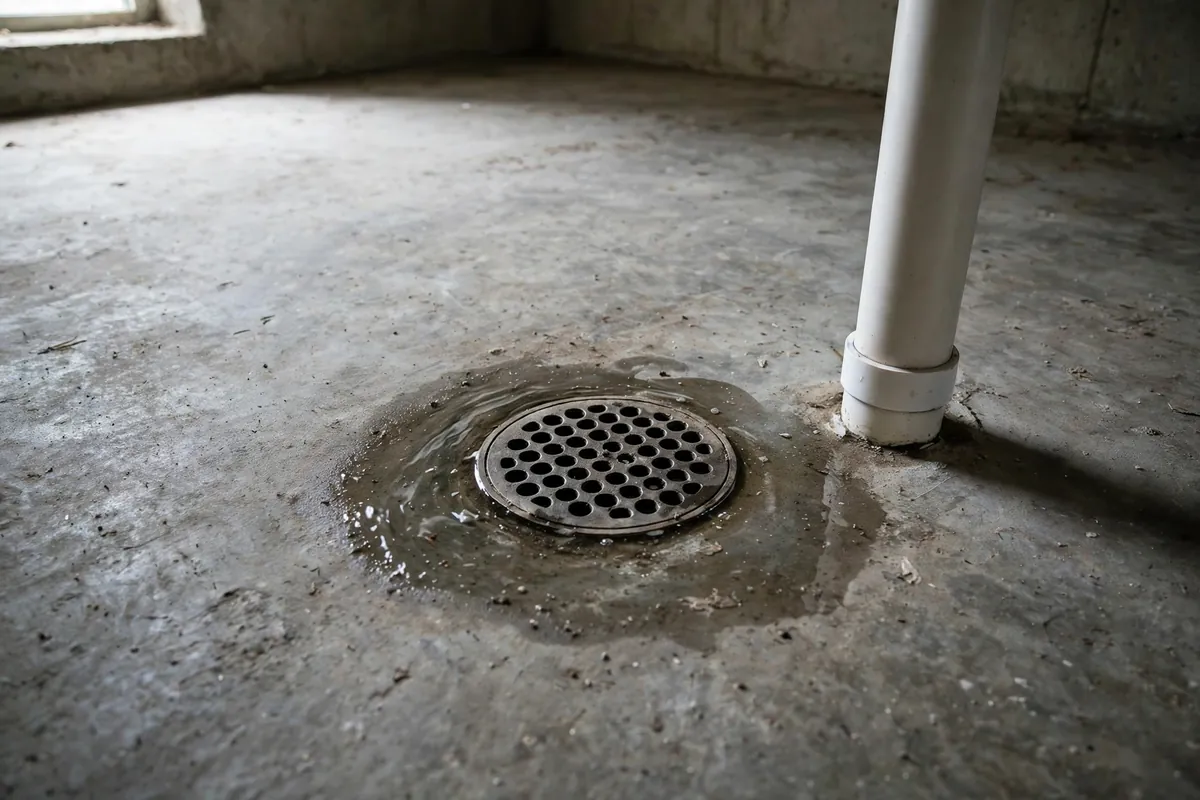
A basement floor drain with standing water from a clogged main sewer line.
Key Takeaways
- The main sewer line serves every drain in the building. A blockage there affects them all at once.
- Several fixtures slow together, a toilet bubbling, and water in a low drain are the classic signs.
- Roots, grease, scale, a sagging pipe and wipes are the common causes in Trenton's older homes.
- Stop using water if a low drain is backing up. Do not flush again, and call for help.
- A camera inspection shows the blockage, the pipe material and the exact location before any repair is discussed.
- A line that clogs every few months has a pipe problem, not a cleaning problem.
What a Clogged Main Sewer Line Is
Every drain in a building joins together into one pipe before it leaves the property. Inside the house that pipe is called the main building drain. Once it passes through the foundation wall and runs underground to the street, it is called the sewer lateral. At the street it connects to the public sewer main, a larger pipe that carries wastewater from many properties to treatment. A clogged main sewer line is a blockage in that single pipe, and because every fixture drains into it, a blockage there affects every fixture at once. That is the difference between a main line clog and a fixture clog: a fixture clog affects one drain, and a main line clog affects them all.
The lateral is usually the property owner's responsibility, from the building to its connection with the public main, while the main itself is the municipality's responsibility, though the exact boundary varies from one New Jersey municipality to another. That distinction matters when a main line clogs, because the first question is whether the blockage is in the lateral or in the public main. If several homes on the same street are backing up at the same time, the blockage may be in the main, and the municipality should be told first. If only one home is affected, the blockage is usually in that home's lateral. A camera inspection with a locator is the evidence that settles the question, because it shows where the blockage sits and how far it is from the building.
In Trenton, a main line clog is often a symptom of an old pipe rather than a single event. About 74% of Trenton homes were built before 1960, according to American Community Survey data reported in 2023, and the laterals under those homes are often as old as the houses themselves. Clay pipe, laid in short sections with mortar joints, lets roots in at every joint. Cast iron corrodes from the inside and narrows over decades. Homes built from the 1940s into the early 1970s may have Orangeburg pipe, a fibre pipe that softens and deforms as it ages. A main line clog in one of these homes is rarely just a clog. It is usually the first visible sign of a pipe that has been narrowing or weakening for years, and the discussion should cover whether the pipe needs cleaning, repair or replacement, not just clearing.
The combined sewer system in Trenton's older sections adds another layer. The city is one of 21 New Jersey municipalities in the New Jersey Department of Environmental Protection's Combined Sewer Overflow program, which means that in older sections the same pipes carry both wastewater and stormwater. In heavy rain the combined flow can rise fast, and a main line that is already narrowed by roots or grease can back up when the storm flow arrives. A main line that clogs only after rain is describing the combined system as much as it is describing a blockage, and the long-term answer may be a backwater valve rather than another round of cleaning. The sewer backup page explains that distinction in detail.
Signs Your Main Sewer Line Is Clogged
| Sign | What it means | What to do |
|---|---|---|
| Several fixtures slow at once | A blockage in the main line that all of them share. | Stop heavy water use and call. This is a main line problem. |
| Toilet bubbles when another fixture runs | Air is trapped by a blockage in the shared line. | Call and describe which fixtures affect each other. |
| Water in a tub or floor drain when you flush | The main line is blocked and water is finding the lowest open drain. | Stop using water and call promptly. Do not flush again. |
| Gurgling from several drains | The drain system is struggling for air because of a partial blockage. | Note which fixtures gurgle and when. Call if it happens regularly. |
| Sewage smell in the home | Wastewater is sitting in a pipe that is not draining, or a trap has been siphoned dry. | Run water into little-used drains. If the smell stays, call. |
| The same problem returns every few weeks | The pipe is narrowed by roots, scale, grease or damage. | Call and ask about a camera inspection so the cause can be seen. |
| A floor drain backs up after rain | Stormwater is raising the level in a combined sewer, or the line is blocked. | Stop using water and call. Note that it happened after rain. |
What Causes a Main Sewer Line to Clog
Tree roots are the most common cause of a main line clog in Trenton's older neighbourhoods. A clay lateral laid in short sections has dozens of mortar joints along its run to the street, and every joint is a place where a fine root can enter. Once inside, the root finds a steady supply of water and nutrients, and it grows into a mat that catches paper, grease and everything else that passes. The drain slows a little more each year, and the first sign is often a toilet that gurgles or a tub that drains slowly. Root cutting clears the mat, but the joint is still open, so roots return unless the pipe is repaired or lined. A camera inspection shows whether roots are entering through one joint or through many, which decides whether a spot repair, a lining or a replacement is the sensible answer. The tree roots page covers this cause in detail.
Grease is the second common cause, and it arrives from the kitchen. Cooking fat poured down a sink cools and hardens on the pipe walls, and in a main line it does the same thing on a larger scale, especially where the line runs under a cold front lawn in winter. The grease narrows the pipe until a normal flush cannot pass cleanly, and food particles catch on the rough surface and build into a blockage. A cable machine can open a hole through grease, but the grease on the walls stays behind, so hydro jetting is usually the right tool for a grease-blocked main line, because high-pressure water scours the walls clean along the full length of the pipe. The hydro jetting page explains the method in detail.
Scale, wipes and pipe damage are the remaining causes. In older cast-iron lines, scale builds up on the inside walls over decades, narrowing the opening until a normal flush cannot pass. Wipes sold as flushable do not break apart in water the way toilet paper does, and they snag on rough joints, root fibres and scale, building into a mass that blocks the line. A section of pipe can sag, forming a low spot where water and solids settle instead of flowing, and a cracked pipe lets soil into the line, which builds into a dam. Each of these needs a camera to confirm, and each has a different answer, from jetting to lining to replacement, which is why the sewer line repair page and the trenchless sewer repair page explain the options in detail.
The pattern of the clog also tells a story. A main line that clogs gradually over months, with drains slowing a little more each week, is usually roots or scale narrowing the pipe. A main line that blocks suddenly, after a single event, is more likely a mass of wipes or a foreign object. A main line that clogs only after heavy rain is describing the combined sewer system rather than a blockage in the house. A main line that clogs only when the washing machine runs is describing a laundry line that cannot handle the volume of water the machine discharges at once. Noting when the clog happens, and what was running at the time, is the detail that turns a vague complaint into a diagnosis.
What to Do First When the Main Line Clogs
Stop using water
Stop using toilets, sinks, showers and the washing machine. Every gallon that goes down a drain has nowhere to go, and it will come back through the lowest open drain in the house.
Do not flush again
If a toilet is already rising or a tub is filling, do not flush again in the hope that it clears. Flushing adds more water to a line that is already full, and it will push water further into the lowest drain.
Keep people and pets away from any water
If wastewater has come up through a drain, keep people and pets away from it. Wastewater is a sanitation problem, not just a plumbing inconvenience, and it should not be touched without protective gear.
Check whether neighbours are affected
If several homes on the same street are backing up at the same time, the blockage may be in the public main, and the municipality should be told first. Note that when you call.
Call and describe the pattern
Call and describe which fixtures are affected, what they are doing, when the problem started, whether it happens after rain, and whether it has happened before. That pattern is the most useful information you can give.
Do not use chemical drain cleaner
Do not use chemical drain cleaner in a main line clog. It can damage older pipes, can splash back and cause burns, rarely clears a real blockage, and creates a hazard for anyone who later opens the pipe.
How a Clogged Main Line Is Fixed
The fix starts with finding the blockage. The professional locates the cleanout, the capped access pipe that gives direct entry to the sewer lateral, and checks the drains at the fixtures to confirm the pattern. A cable machine is then fed through the cleanout to break through the blockage and cut any roots, and the cable is worked back and forth until water flows through the line again. If the line is blocked by grease or scale, hydro jetting follows, to scour the walls clean along the full length of the pipe. Water is then run through the fixtures to confirm the line flows properly, and a camera is run through the line when the problem has recurred or a damaged pipe is suspected, so the condition of the pipe is known before the visit ends.
The camera is the step that decides what happens next. If it shows a clean pipe with no damage, the blockage was material inside the pipe, and the fix is cleaning plus a change in the habits that caused it. If it shows roots entering through one joint, a spot repair or a short lining may be enough. If it shows roots entering through many joints, or cracks along the whole line, a full lining or replacement may be the better answer. If it shows a collapse or a deep belly, the pipe has to be replaced, either by pipe bursting or by open excavation. Each of those is a different job, with a different amount of digging and a different result, and the camera is what separates them. The sewer line cleaning, sewer line repair and trenchless sewer repair pages explain each one in detail.
There is also a question to ask after the line is cleared: how often will it need cleaning again. A newer home with plastic pipe and no large trees over the lateral may go years without needing a main line cleaning. An older home with clay pipe and mature trees over the line may need the main line cleaned once a year, or every couple of years, to keep roots from building into a blockage. The practical rule is to let the line tell you: if a main line that was cleaned starts slowing again after a few months, the interval is too long, or the pipe has a problem that cleaning alone cannot fix. The local professional who has seen the inside of the line can discuss a sensible interval for that particular home.
Call for a Clogged Main Sewer Line in Trenton
Several drains slow at once, or water backing up through a low drain in Trenton? Stop using water and call now to describe the problem and connect with an independent local drain professional.
Trenton Drain Pros is a referral service connecting callers with an independent local service provider; the provider is responsible for diagnosis, pricing, scheduling, licensing and the work performed.
Frequently Asked Questions
What are the signs of a main sewer line blockage?
The classic signs are several fixtures draining slowly at the same time, a toilet that bubbles or gurgles when another fixture is used, water appearing in a tub, shower or floor drain when a toilet is flushed or the washing machine runs, a sewage smell in the home, and a drain problem that returns every few weeks. Any one of those signs points to the main line rather than a single fixture.
What should I do when my main sewer line clogs?
Stop using all water, including toilets, sinks, showers and the washing machine. Do not flush again, keep people and pets away from any wastewater, and call for help. Do not use chemical drain cleaner. If several homes on the same street are affected, the blockage may be in the public main, and the municipality should be told first.
Can I clear a main sewer line myself?
A plunger can clear a single clogged fixture, but it cannot clear a main sewer line, because the blockage is usually tens of feet from the house, under the front lawn. A cable machine fed through a cleanout is the tool that reaches it, and a camera inspection is the step that shows what the blockage is. A main line clog is a reason to call, not a do-it-yourself job.
Why does my main sewer line keep clogging every few months?
A main line that clogs every few months usually has a pipe problem, not a cleaning problem. Roots entering through open joints, grease coating the walls, scale narrowing an old cast-iron line, or a sagging section of pipe will all cause the line to clog again as soon as the cleaning wears off. A camera inspection shows the cause inside the pipe, which is the step that stops the cycle.
What is the difference between a main line clog and a fixture clog?
A fixture clog affects one drain, such as a single sink or toilet, and it is usually a local blockage in that fixture's own pipe. A main line clog affects every drain in the building at once, because every fixture drains into the same main line. If several fixtures are slow together, the problem is in the main line.
Does a clogged main line always need a camera inspection?
Not always for a first clog that clears well and stays clear. A camera inspection is the right step when the clog keeps returning, when several fixtures are affected, when the house is several decades old, or when a repair is being considered, because it shows the condition of the pipe and the exact location of the problem.
Can tree roots clog a main sewer line?
Yes, and in Trenton they are one of the most common causes. Roots enter older clay laterals through mortar joints, grow into a mat inside the pipe, and catch paper, grease and everything else that passes. Root cutting clears the mat, but the joint is still open, so roots return unless the pipe is repaired or lined. The tree roots page explains the options in detail.
What if my neighbours have the same main line problem?
If several homes on the same street are backing up at the same time, the blockage may be in the public sewer main rather than in any one home's lateral. Tell the municipality first, because the main is the municipality's responsibility. If only your home is affected, the blockage is usually in your lateral, and a local professional can help.
Need Drain Cleaning Help? Call Now
Describe the drain problem and discuss the help available for your specific situation.