Trenchless Sewer Repair in Trenton, NJ
Trenchless sewer repair fixes or replaces a sewer line from inside the pipe, or by pulling a new pipe through the old one, with far less digging than open excavation. Instead of a trench along the whole length of the line, there are usually two small access pits, one at each end of the section being repaired. This page explains the two main trenchless methods, pipe lining and pipe bursting, when each one fits, and when open excavation is still the right answer.
Drain and sewer assistance for homes, rentals, and local properties in Trenton, NJ.
Calls may be routed to an independent local service provider.
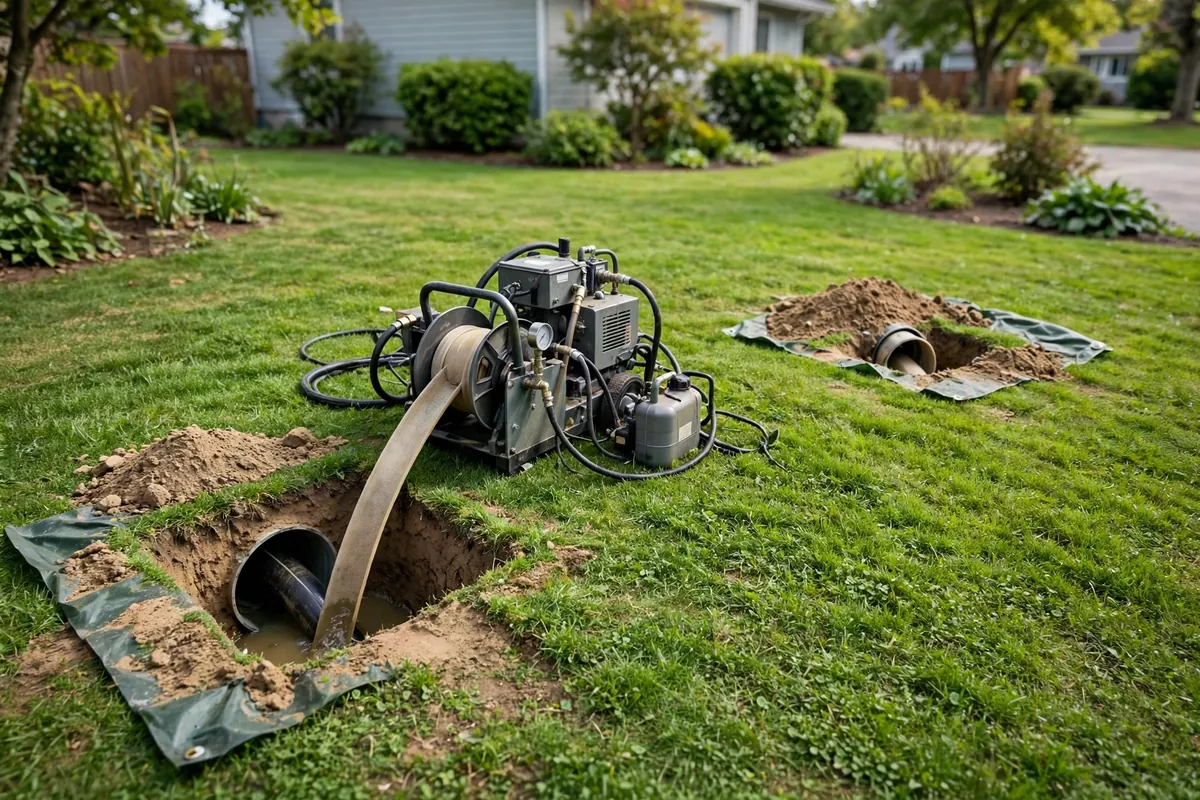
Trenchless repair equipment with small access pits and the lawn mostly intact.
Key Takeaways
- Trenchless repair fixes a sewer line with small access pits instead of a trench along the whole line.
- Pipe lining forms a new pipe inside the old one. Pipe bursting pulls a new pipe through as the old one is broken apart.
- Lining suits a pipe that still holds its shape but is cracked or leaking at the joints. Bursting suits a pipe that is collapsed or badly damaged.
- A camera inspection comes first. It shows whether the pipe can be lined or burst, and where the access pits should go.
- Trenchless methods do not fit every line. A collapsed pipe with no opening, or a line with a deep belly, may still need excavation.
- The surface above the line, lawn, driveway or sidewalk, is disturbed far less with trenchless methods than with a trench.
What Trenchless Sewer Repair Means
Trenchless sewer repair is a set of methods for repairing or replacing an underground sewer line without digging a trench along its whole length. The traditional method, open excavation, digs a trench from the house to the street, removes the old pipe, lays a new one, and backfills the trench. It works, but it disturbs everything above the line: the lawn, the garden, the driveway, the sidewalk, and anything planted over the pipe. Trenchless methods avoid most of that digging by working from inside the pipe, or by pulling a new pipe through the old one, with access needed only at the ends of the section being repaired.
There are two main trenchless methods, and they solve different problems. Pipe lining, also called cured-in-place pipe lining, forms a new pipe inside the old one. A flexible liner soaked in resin is inserted into the old pipe, inflated so it presses against the inside walls, and cured until it hardens into a smooth, jointless pipe within the old pipe. Pipe bursting does the opposite: a bursting head is pulled through the old pipe, breaking it apart, and a new pipe is pulled in behind it, taking the place of the old one. Lining keeps the old pipe as a shell. Bursting replaces it entirely. Which one fits depends on the condition of the old pipe, and a camera inspection is what decides.
Trenchless repair is especially relevant in Trenton, where the laterals under older homes are often clay or cast iron, and where the line runs under a front lawn, a driveway or a sidewalk that a homeowner does not want dug up. About 74% of Trenton homes were built before 1960, according to American Community Survey data reported in 2023, and many of those laterals are clay pipe with mortar joints that have cracked and let roots in along their whole length. A line like that is a good candidate for lining, because the old pipe still holds its shape well enough to contain a liner, and lining seals every joint at once. A line that has collapsed, or that has sagged badly, is a different case, and bursting or excavation may be the answer instead.
Trenchless work is not a do-it-yourself job, and it is not a job for a general handyman. It needs a camera inspection first, a clean line to work in, the right equipment for the length and diameter of the pipe, and a provider who is responsible for the work performed, including the licensing and the permits that apply when work is done in or near a public street. The discussion on this page is general guidance about the methods. The decision about which method fits a particular line is made after the camera inspection, when the condition of the pipe is known.
Pipe Lining and Pipe Bursting Compared
| Factor | Pipe lining (CIPP) | Pipe bursting |
|---|---|---|
| What it does | Forms a new, jointless pipe inside the old one. | Breaks the old pipe apart and pulls a new pipe into its place. |
| Best for | Cracks, leaking joints, root damage, where the old pipe still holds its shape. | Collapsed, badly damaged or undersized pipe that needs a full replacement. |
| Digging needed | Usually two small access pits, one at each end. | Usually two small access pits, one at each end. |
| Pipe diameter | Slightly smaller inside, because the liner sits within the old pipe. | Same size or larger, because the new pipe replaces the old one. |
| When it does not fit | A collapsed pipe, a deep belly, or a pipe with no opening for the liner. | A line with no room for the pulling equipment, or where the line runs too close to other utilities. |
| What happens to the old pipe | It stays in the ground as a shell around the new liner. | It is broken apart and left in the ground in fragments. |
How Pipe Lining Works
Pipe lining starts with a clean line. The lateral is cleaned first, usually with a cable machine to cut roots and hydro jetting to scour the walls, because the liner has to press tightly against the inside of the old pipe, and any debris in the way will prevent a proper bond. A camera is then run through the line to confirm it is clean and to measure the length and diameter, so the liner can be cut to the right size. The liner itself is a flexible tube, usually felt or fibreglass, soaked in a resin that hardens when it is heated or exposed to ultraviolet light.
The liner is inserted into the old pipe, usually from a cleanout or from one of the access pits, and it is inflated with air or water so it presses against the inside walls of the old pipe along its full length. The resin is then cured, either with hot water, steam or ultraviolet light, until it hardens into a smooth, jointless pipe inside the old one. The result is a new pipe with no joints for roots to enter, a smooth inside surface that water flows through easily, and a structure that is supported by the old pipe around it. The lateral connections, where branch lines join the main line, are reopened from inside the pipe with a robotic cutter after the liner has cured.
Lining has a clear advantage for a line with many damaged joints. A clay lateral with roots entering through a dozen joints would need a dozen spot repairs by excavation, but a single lining seals all of them at once. It also has a limit: the new pipe sits inside the old one, so the inside diameter is slightly smaller than before, which matters in a line that is already narrow. And it needs a pipe that still holds its shape. A collapsed section has no opening for the liner to pass through, and a deep belly will still be a low spot after lining, because the liner follows the shape of the old pipe. A camera inspection before lining shows whether those limits apply.
The curing process and the resin used are matters for the provider, who is responsible for the work performed. A homeowner does not need to know the chemistry, but it is worth knowing that the line cannot be used while the liner is curing, and that the lateral connections need to be reopened afterwards, so a lining job is a planned visit rather than an emergency one. The local professional can discuss the timing and what needs to happen before the visit, including cleaning the line and locating the cleanout.
How Pipe Bursting Works
Pipe bursting starts with two access pits, one at each end of the section being replaced. A bursting head, a cone-shaped tool slightly larger than the old pipe, is attached to a new pipe, usually high-density polyethylene, and pulled through the old line by a winch or a hydraulic puller. As the head moves through the old pipe it breaks the old pipe apart, pushing the fragments out into the surrounding soil, and the new pipe follows behind it into the space the old pipe occupied. The new pipe is jointless along its length, so there are no joints for roots to enter, and it can be the same size as the old pipe or larger, which is an advantage when the old line was undersized.
Bursting is the right answer when the old pipe is too damaged to line. A collapsed section cannot be lined, because there is no opening for the liner, but it can be burst, because the bursting head breaks through the collapsed material as it moves. A line with a deep belly can be burst and replaced at the correct fall, which lining cannot do. A line that needs a larger diameter, because the household has grown or the old line was always too small, can be upsized by bursting, because the bursting head makes room for a larger pipe. Each of these is a case where the old pipe has to go, not just be sealed from the inside.
Bursting has its own limits. It needs room for the pulling equipment at both ends, and it needs a clear path: a line that runs very close to other underground utilities, a gas line, a water line or an electric cable, may not be safe to burst, because the bursting head displaces soil as it moves. The depth of the line matters too, and so does the soil. A camera inspection and a utility check come before any bursting job, and the provider is responsible for those checks. Bursting also disturbs the ground more than lining, because the old pipe is broken apart rather than left in place, but it still disturbs far less than an open trench along the whole line.
The choice between lining and bursting is made after the camera inspection, when the condition of the pipe is known. A line that is cracked but still holds its shape is usually a lining job. A line that has collapsed, sagged badly or needs to be larger is usually a bursting job. A line that has both problems, a collapsed section in one place and cracked joints elsewhere, may need a combination, or open excavation for the collapsed section and lining for the rest. The local professional can discuss the combination that fits the line, once the camera findings are known.
When Trenchless Repair Does Not Fit
There are lines where trenchless methods do not fit, and it is important to know that before a job is planned. A pipe that has collapsed completely, with the fragments blocking the line, may not let a bursting head through, and it certainly will not let a liner through. A line with a deep belly needs to be re-laid at the correct fall, which means digging, because neither lining nor bursting can correct the shape of the ground under the pipe. A line that has been repaired so many times that it is a patchwork of different materials may not have a consistent diameter for a liner, and a line that runs under a structure, or too close to other utilities, may not be safe to burst.
Access can also be a limit. Trenchless methods need access pits at both ends of the section being repaired, and those pits need to be in places where digging is possible: a lawn, a garden bed, a driveway that can be cut and restored. A line that runs under a building, under a large tree that cannot be disturbed, or under a road where digging is not permitted may need a different approach. The provider can discuss the access and the permits that apply, including any permit needed when work is done in or near a public street in New Jersey, and the homeowner does not need to arrange those permits themselves.
The honest way to think about trenchless repair is that it is the right answer for many lines, but not for all of them. A camera inspection is the step that separates the two. It shows the condition of the pipe, the kind of damage, the depth and the location, and it lets the provider discuss the choices that actually fit, rather than the choices that sound best. If a provider recommends a trenchless method without a camera inspection, or without explaining why the other methods do not fit, that is a reason to ask more questions before agreeing to the work.
Call for Trenchless Sewer Repair in Trenton
A damaged sewer line in Trenton and a yard you do not want dug up? Call now to describe the problem and connect with an independent local drain professional who can discuss whether trenchless repair fits your line.
Trenton Drain Pros is a referral service connecting callers with an independent local service provider; the provider is responsible for diagnosis, pricing, scheduling, licensing and the work performed.
Frequently Asked Questions
What is trenchless sewer repair?
Trenchless sewer repair fixes or replaces an underground sewer line with far less digging than open excavation. The two main methods are pipe lining, which forms a new pipe inside the old one, and pipe bursting, which pulls a new pipe through as the old one is broken apart. Both usually need only two small access pits instead of a trench along the whole line.
How do I know if my sewer line can be repaired trenchlessly?
A camera inspection decides. It shows the kind of damage, the condition of the pipe, and whether the pipe still holds its shape. Lining needs a pipe that holds its shape. Bursting needs a clear path and room for the pulling equipment. A collapsed pipe with no opening, or a line with a deep belly, may still need excavation.
Does pipe lining make the pipe smaller?
Yes, slightly. The liner sits inside the old pipe, so the inside diameter is a little smaller than before. The liner is smooth and jointless, so water flows through it easily, and in most cases the smoother surface makes up for the small loss of diameter. If the old line was already narrow, pipe bursting, which can use a larger pipe, may be the better choice.
How long does a trenchless sewer repair take?
That depends on the length of the line, the method used, and the condition of the pipe. A lining job is usually a planned visit that takes the better part of a day, including cleaning the line first and reopening the lateral connections afterwards. Pipe bursting takes longer because of the access pits and the pulling work. The local professional can discuss timing when the camera findings are known.
Will trenchless repair stop tree roots?
Yes, when the method fits the line. A lining creates a jointless pipe with no joints for roots to enter, and a new pipe installed by bursting is also jointless along its length. Roots can still enter at a connection that was not sealed, which is why the lateral connections are reopened and checked after a lining, and why a camera inspection afterwards confirms the result.
Can trenchless repair fix a collapsed sewer line?
Pipe bursting can sometimes fix a collapsed line, because the bursting head breaks through the collapsed material as it moves. Pipe lining cannot, because there is no opening for the liner to pass through. A completely collapsed line with fragments blocking the way may still need open excavation. A camera inspection shows which case applies.
What happens to my lawn or driveway with trenchless repair?
Far less than with open excavation. Trenchless methods usually need two small access pits, one at each end of the section being repaired, and the surface around each pit is restored afterwards. A lawn, a garden bed or a driveway section at each pit is disturbed, but there is no trench along the whole line.
Do I need a permit for trenchless sewer repair in New Jersey?
Work that opens a public street or connects to a public sewer often needs a permit in New Jersey, and the work usually has to be done by a plumber who holds the relevant New Jersey licence. The local provider is responsible for licensing and for the work performed, including any permit that applies. A homeowner does not need to arrange the permit themselves.
Need Drain Cleaning Help? Call Now
Describe the drain problem and discuss the help available for your specific situation.