Sewer Line Cleaning in Trenton, NJ
Sewer line cleaning clears and cleans the main sewer line that carries wastewater from a home or business to the public sewer main in the street. It is the work that fixes the problems a fixture drain cannot explain: several drains slow at once, a toilet bubbling when the washing machine runs, and a floor drain backing up when a lot of water is used. This page explains what sewer line cleaning includes, how it is done, and when a camera inspection should come first.
Drain and sewer assistance for homes, rentals, and local properties in Trenton, NJ.
Calls may be routed to an independent local service provider.
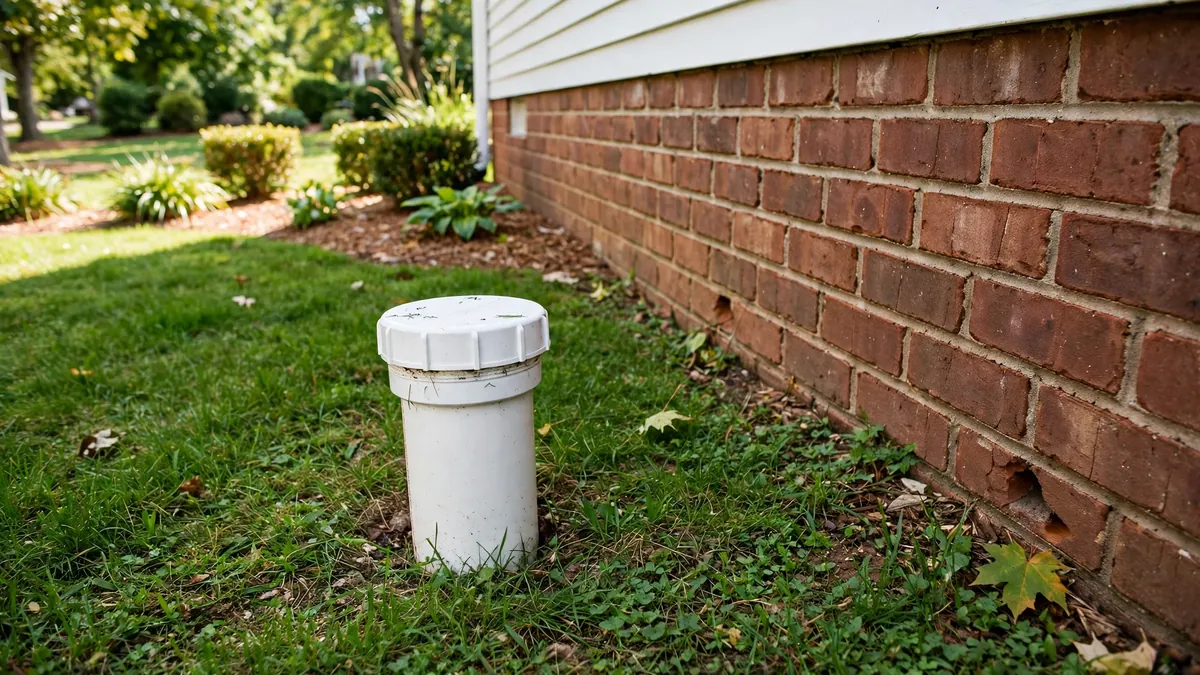
A sewer cleanout pipe access point in a residential yard.
Key Takeaways
- The sewer line is the single pipe that serves every drain in the building. A blockage there affects them all.
- Roots, grease, scale and settled debris are the usual causes of a blocked main line in Trenton.
- A cable machine cuts roots and breaks through blockages. Hydro jetting scours the pipe walls clean.
- A camera inspection shows the cause, the pipe material and the exact location before any repair is discussed.
- The property owner is usually responsible for the lateral from the building to its connection with the public main. The municipality is usually responsible for the main itself, though the exact boundary varies by municipality in New Jersey.
- A main line that needs cleaning every few months has a pipe problem, not a cleaning problem.
What the Sewer Line Is
Every drain in a building joins together into one pipe before it leaves the property. Inside the house that pipe is called the main building drain. Once it passes through the foundation wall and runs underground to the street, it is called the sewer lateral. At the street it connects to the public sewer main, a larger pipe that carries wastewater from many properties to treatment. The lateral is usually the property owner's responsibility, from the building to its connection with the main, while the main itself is the municipality's responsibility, though the exact boundary varies from one New Jersey municipality to another, and Trenton callers should confirm the boundary for their street with the local provider when they call.
The lateral is the longest single pipe on a property, and it is also the one that is hardest to see. It runs several feet underground, under the front lawn, a driveway or a sidewalk, and it is usually as old as the house itself. In Trenton, where about 74% of homes were built before 1960, that means a lateral laid with the materials of its era: clay pipe in short sections joined with mortar, cast iron for the section nearest the foundation, and in homes built from the 1940s into the early 1970s, sometimes Orangeburg pipe, a fibre pipe made from wood pulp and pitch. Each of those materials has its own way of failing, and the failure usually shows up first as a drain problem inside the house, long before anything is visible outside.
Because the lateral serves every fixture, its symptoms are different from a fixture clog. A single slow sink is a fixture problem. Several fixtures slow at once, a toilet that bubbles when the washing machine runs, a tub that fills when a toilet is flushed, or a floor drain that backs up when a lot of water is used, are all main line symptoms. The water has nowhere to go, so it finds the lowest open drain and comes back through it. That is why the first question in a sewer line visit is always about the pattern: which fixtures are affected, and which ones affect each other. The pattern narrows the location before any tool is used.
The lateral also has a cleanout in many homes, a capped access pipe that gives direct entry to the line. It is usually outside near the foundation, sometimes in a basement, and sometimes buried under a lawn or a garden bed. A cleanout makes sewer line cleaning faster and less disruptive, because the cable or jetter can be fed straight into the lateral without going through a fixture. If you know where yours is, tell the professional when you call. If you do not know, do not dig for it. The provider can locate the line and the cleanout when they arrive, and a camera inspection can confirm where the line runs and where any problem sits.
Signs the Main Sewer Line Needs Cleaning
- Several fixtures drain slowly at the same time, especially on the lowest floor of the house.
- A toilet bubbles, gurgles or loses water level when another fixture is used.
- Water appears in a tub, shower or floor drain when a toilet is flushed or the washing machine drains.
- A sewage smell appears in the home, especially near a floor drain or in the basement.
- The same drain clogs every few weeks, even though each individual fixture seems fine.
- A green or unusually lush strip of lawn runs along the path of the sewer line.
- A floor drain backs up during heavy rain, or after a lot of water is used at once.
- Drains are slow throughout the house, but a plunger clears each one only briefly.
What Blocks a Main Sewer Line
Tree roots are the most common cause of a blocked main line in Trenton's older neighbourhoods. A clay lateral laid in short sections has dozens of mortar joints along its run to the street, and every joint is a place where a fine root can enter. Once inside, the root finds a steady supply of water and nutrients, and it grows into a mat that catches paper, grease and everything else that passes. The drain slows a little more each year, and the first sign is often a toilet that gurgles or a tub that drains slowly. Root cutting clears the mat, but the joint is still open, so roots return unless the pipe is repaired or lined. A camera inspection shows whether roots are entering through one joint or through many, which decides whether a spot repair, a lining or a replacement is the sensible answer.
Grease is the second common cause, and it arrives from the kitchen. Cooking fat poured down a sink cools and hardens on the pipe walls, and in a main line it does the same thing on a larger scale, especially where the line runs under a cold front lawn in winter. The grease narrows the pipe until a normal flush cannot pass cleanly, and food particles catch on the rough surface and build into a blockage. A cable machine can open a hole through grease, but the grease on the walls stays behind, so hydro jetting is usually the right tool for a grease-blocked main line, because high-pressure water scours the walls clean along the full length of the pipe.
Scale and corrosion narrow older cast-iron lines from the inside. Cast iron was common for the section of lateral nearest the foundation and for the drain stacks inside the house, and over decades acidic wastewater and mineral deposits eat at the metal and build up a rough, crusty layer inside the pipe. The opening shrinks, the rough surface catches debris, and the line clogs with less and less provocation. Descaling with a cable or a jetter can restore the opening, but it also thins a pipe that is already weakened, so a camera inspection matters before descaling an old cast-iron line: it shows whether the pipe is thick enough to clean safely or whether it is near the end of its life.
Settled debris and pipe damage are the remaining causes. A section of pipe can sag, forming a low spot where water and solids settle instead of flowing, and the settled material builds into a blockage that clearing cannot remove permanently. A cracked pipe lets soil into the line, and the soil builds into a dam. A collapsed section blocks the line completely. Wipes, paper towels and other items that should never be flushed can also form a mass in a main line, often wrapped around roots or caught at a joint where the pipe has shifted. Each of these needs a camera to confirm, and each has a different answer, from jetting to lining to replacement, which is why the sewer line repair page and the trenchless sewer repair page explain the options in detail.
How Sewer Line Cleaning Works
Find the cleanout and check the pattern
The professional asks which fixtures are affected, checks the drains at the fixtures, and locates the cleanout if there is one. The pattern of symptoms shows whether the blockage is in the lateral or in the public main.
Run a camera if the cause is not obvious
When the problem keeps returning, or when a repair is being considered, a camera is pushed through the line to show the blockage, the pipe material, cracks, roots, sags and the exact distance to the problem.
Cut roots and break through the blockage
A cable machine with a cutting head is fed through the cleanout to break through the blockage and cut roots. The cable is worked back and forth until water flows through the line again.
Jet the line clean
Hydro jetting scours the inside walls of the pipe with high-pressure water, removing grease, scale and debris along the full length of the line, not just at the point of the blockage.
Check the result with water and camera
Water is run through the fixtures to confirm the line flows properly, and a camera is run again when the line has a history of problems, so the condition of the pipe is known before the visit ends.
Cable Cleaning and Hydro Jetting Compared
| Approach | What it does | Best for | Limits |
|---|---|---|---|
| Cable machine | A rotating cable with a cutting head breaks through blockages and cuts roots. | Root mats, solid blockages, and opening a line that is completely blocked. | Opens a path but leaves grease and scale on the pipe walls. |
| Hydro jetting | High-pressure water scours the inside of the pipe along its length. | Grease, scale and heavy buildup; cleaning a line after roots are cut. | Not suitable for a pipe that is already collapsed or badly cracked. |
| Camera inspection | Shows the inside of the pipe, the material, and the exact location of the problem. | Recurring blockages, suspected damage, and confirming a repair. | It diagnoses; it does not clean on its own. |
| Root cutting plus jetting | Cutting removes the root mat, jetting washes the walls clean behind it. | A main line with both roots and grease or scale buildup. | Roots will return through an open joint unless the pipe is repaired or lined. |
Who Is Responsible for the Sewer Line in New Jersey
Sewer line responsibility in New Jersey is not set by a single statewide rule. It varies by municipality, and the boundary is set by the local sewer code or ordinance. The common pattern, seen in the published sewer rules of several New Jersey municipalities, is that the property owner is responsible for the lateral, the pipe that runs from the building to its connection with the public sewer main, including the full length of that pipe even where part of it lies under a sidewalk or in the street. The municipality is responsible for the public sewer main itself, the larger pipe in the street that serves many properties. In some municipalities the city will clear a blockage in the portion of the lateral beyond the curb at the owner's expense, and in others the owner is responsible for the whole lateral outright.
That variation is why the question matters before any work starts. If the blockage is in the public main, the municipality should be told first, because a blockage in the main can back up several homes on the same street at once, and the municipality is the party that can clear it. If the main is flowing and the trouble sits on the private side of the connection, the lateral is the owner's to find and fix. A camera inspection with a locator is the evidence that settles the question: it shows where the blockage sits, how far it is from the building, and whether it is in the lateral or in the main. The local professional can discuss what the camera shows and who should be contacted, and Trenton callers should confirm the exact boundary for their street with the local provider when they call.
A related question is what happens when a sewer line needs work in the street. In many New Jersey municipalities, work that opens a public street or connects to a public sewer needs a permit, and the work has to be done by a plumber who holds the relevant New Jersey licence. That is a matter for the local provider, who is responsible for licensing and for the work performed, as the referral disclosure on this site explains. A homeowner does not need to arrange the permit themselves, but it is worth knowing that a sewer line repair is not a job that can be done quietly without the municipality knowing, and that a proper repair includes restoring the street, the sidewalk and the lawn afterwards. The trenchless sewer repair page explains how lining and pipe bursting can reduce the digging involved.
Keeping a Main Sewer Line Clear
The habits that keep a main line clear are the same ones that keep a fixture drain clear, applied to the whole house. Only toilet paper and human waste go down a toilet. Cooking grease goes in the bin once it has cooled, not down the kitchen sink. A drain strainer in every shower and bathroom sink catches hair before it reaches the line. A garbage disposal is not a bin: food scraps, coffee grounds, rice and fibrous vegetables belong in the bin or in compost, not in the drain. These are small habits, but a main line is a shared pipe, and a habit that is harmless in one fixture becomes a blockage when it is repeated across a whole household.
Trees need a different kind of attention. A large tree over or near the sewer line will send roots toward it, and there is no way to stop that without removing the tree or repairing the pipe. What can be done is to keep the line cleaned on a sensible interval, so roots are cut before they build into a blockage, and to have a camera inspection when the interval between cleanings starts shrinking. If a camera shows roots entering through one joint, a spot repair or a short lining may be enough. If roots are entering through many joints, a full lining or replacement may be the better answer. The tree roots page explains the options in detail, including what a camera report should show.
A planned cleaning interval is worth discussing for an older home. A newer home with plastic pipe and no large trees over the lateral may go years without needing a main line cleaning. An older home with clay pipe and mature trees over the line may need the main line cleaned once a year, or every couple of years, to keep roots from building into a blockage. The practical rule is to let the line tell you: if a main line that was cleaned starts slowing again after a few months, the interval is too long, or the pipe has a problem that cleaning alone cannot fix. The local professional who has seen the inside of the line can discuss a sensible interval for that particular home.
Call for Sewer Line Cleaning in Trenton
Several drains slow at once, or a floor drain backing up in Trenton? Call now to describe the problem and connect with an independent local drain professional who can discuss the help available.
Trenton Drain Pros is a referral service connecting callers with an independent local service provider; the provider is responsible for diagnosis, pricing, scheduling, licensing and the work performed.
Frequently Asked Questions
How do I know if the blockage is in my sewer line or in the public main?
If only your home is affected, the blockage is usually in your lateral. If several homes on the same street are backing up at the same time, the blockage may be in the public main, and the municipality should be told first. A camera inspection with a locator shows where the blockage sits and whether it is in the lateral or in the main.
What is the main sewer line cleaning process?
The professional locates the cleanout, checks which fixtures are affected, and runs a cable machine through the line to break through the blockage and cut roots. Hydro jetting often follows to scour grease and scale from the pipe walls. Water is then run through the fixtures to confirm the line flows, and a camera is used again when the line has a history of problems.
How often should a main sewer line be cleaned?
That depends on the age of the pipe, the trees nearby, and how the drains are used. A newer home with plastic pipe may go years without a main line cleaning. An older home with clay pipe and mature trees over the line may need cleaning once a year or every couple of years. Let the line tell you: if it slows again within months, the interval is too short or the pipe needs repair.
Can roots be removed from a sewer line without digging?
Yes. Roots are cut with a cable machine fed through a cleanout, and hydro jetting washes the cut material out of the line. Digging is only needed when the pipe itself has to be repaired or replaced, and trenchless lining can often repair a root-damaged line without open excavation.
Why does my sewer line back up when it rains?
In older sections of Trenton, the same underground pipes carry both wastewater and stormwater, because the city is one of 21 New Jersey municipalities in the state's Combined Sewer Overflow program. In heavy rain the combined flow can rise fast, and the lowest drains in a house are the first place the pressure shows. A backwater valve is the long-term protection against that kind of backup.
What is a sewer lateral?
A sewer lateral is the underground pipe that runs from a building to the public sewer main in the street. It carries all of the wastewater from the building. The property owner is usually responsible for the lateral from the building to its connection with the main, while the municipality is usually responsible for the main itself, though the exact boundary varies by municipality in New Jersey.
Should I have my sewer line inspected before buying a home in Trenton?
Yes, it is a sensible step, especially for an older home. A general home inspection does not usually cover a buried sewer lateral, so a camera inspection is the only way to know the material and condition of the line before purchase. It can show roots, cracks, sags and collapsed sections that would otherwise be discovered only after a backup.
What should I tell the professional when I call about a sewer line?
Describe which fixtures are affected, what they are doing, when the problem started, whether it happens after rain, whether it has happened before, and whether neighbours on the same street have the same problem. Note the age of the house and whether there are large trees near the sewer line, and mention where the cleanout is if you know.
Need Drain Cleaning Help? Call Now
Describe the drain problem and discuss the help available for your specific situation.