Sewer Line Repair in Trenton, NJ
Sewer line repair fixes a sewer lateral that is cracked, collapsed, sagging, root-damaged or otherwise no longer carrying wastewater properly. Cleaning can clear a blockage, but it cannot fix a pipe that has lost its shape, and a line that needs cleaning every few months is usually a line that needs repair. This page explains the signs of a damaged sewer line, the repair choices, and what happens when you call in Trenton.
Drain and sewer assistance for homes, rentals, and local properties in Trenton, NJ.
Calls may be routed to an independent local service provider.
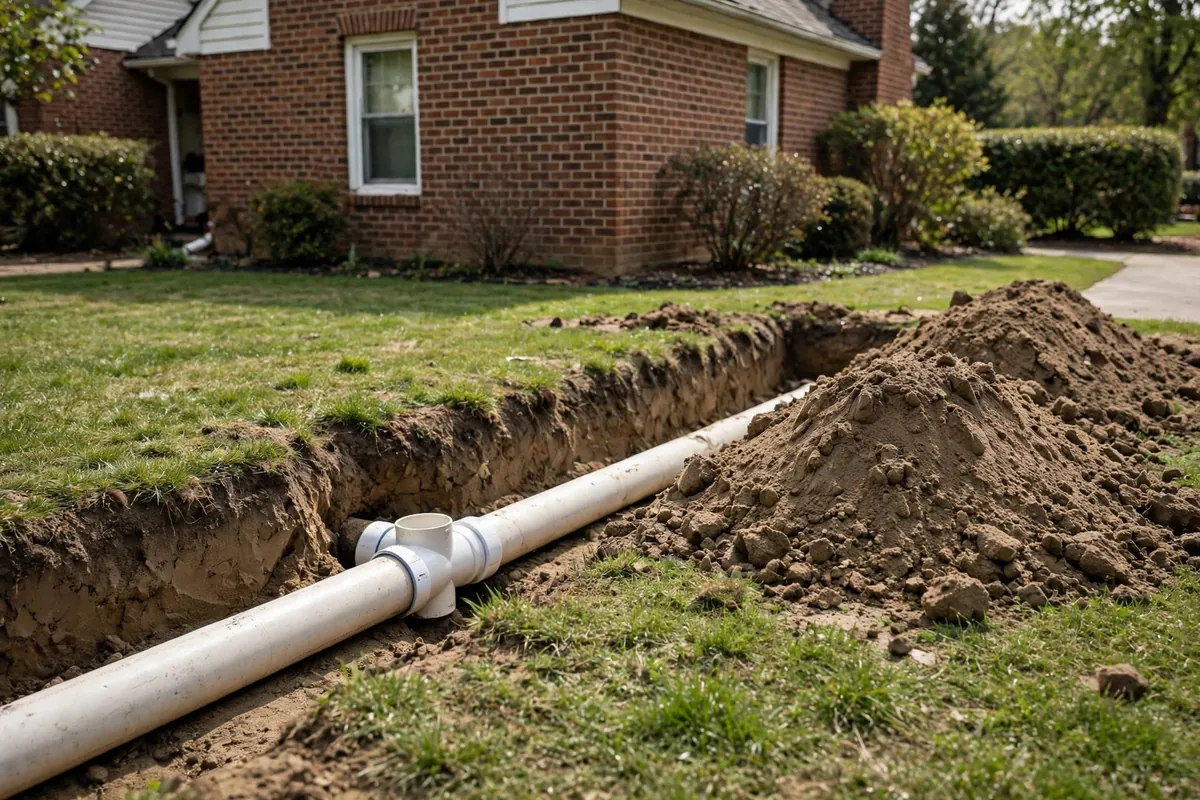
An excavated trench showing a sewer pipe section during repair.
Key Takeaways
- Cleaning clears a blockage. Repair fixes the pipe. A line that keeps clogging after cleaning usually needs repair.
- Cracks, collapses, bellies, offset joints and root damage are the common kinds of sewer line damage in Trenton.
- A camera inspection shows the damage, the pipe material and the exact location before any repair is discussed.
- Trenchless repair, lining or pipe bursting, can often fix a line with far less digging than open excavation.
- The property owner is usually responsible for the lateral to its connection with the public main. The exact boundary varies by municipality in New Jersey.
- A sewer line inspection before buying an older home in Trenton can show damage that a general home inspection does not cover.
What Sewer Line Repair Covers
Sewer line repair is the work of fixing a sewer lateral that is damaged rather than merely blocked. The distinction is important, because the two problems look the same from inside the house: slow drains, recurring clogs, gurgling fixtures and sewage smells can all be caused by either one. The difference is what a camera shows inside the pipe. A blocked pipe is full of material that can be removed. A damaged pipe has lost its shape, and no amount of clearing will restore it. A crack lets soil and roots in. A collapsed section has no opening at all. A bellied section sags and collects water and solids. An offset joint has shifted so that one section of pipe no longer lines up with the next, creating a lip that catches everything that passes.
The repair choices depend on the kind and the extent of the damage. A single cracked joint can sometimes be repaired at that one point, with a short excavation to expose the joint and replace the damaged section. A line with several damaged joints, or with roots entering along its whole length, may be a candidate for lining, where a new pipe is formed inside the old one, or for pipe bursting, where a new pipe is pulled through the old one as the old pipe is broken apart. A collapsed line, or a line that has sagged badly along a long section, may need open excavation and replacement of the damaged length. Each choice has pipes it suits and pipes it does not, and the camera inspection is what decides which one fits the line in front of them.
Sewer line repair in Trenton is shaped by the age of the housing. About 74% of Trenton homes were built before 1960, according to American Community Survey data reported in 2023, and the laterals under those homes are often as old as the houses themselves. Clay pipe, laid in short sections with mortar joints, cracks when the ground moves and lets roots in at every joint. Cast iron corrodes from the inside and thins until it can no longer hold its shape. Orangeburg pipe, used in homes built from the 1940s into the early 1970s, softens and deforms under soil load as it ages, losing its round shape until it pinches shut. A repair in one of these homes is rarely just a repair: it is a decision about a pipe that has reached the end of the life it was built for, and the discussion should cover whether a spot repair, a lining or a full replacement is the sensible answer for that particular line.
The work itself also involves the ground above the pipe. A sewer lateral runs under a front lawn, a driveway, a sidewalk or a garden, and any repair that involves digging will disturb that surface. Trenchless methods were developed to reduce that disturbance, and they are covered in detail on the trenchless sewer repair page. Even with trenchless methods, there are usually two small access pits, one at each end of the section being repaired, and the surface is restored afterwards. With open excavation, a trench is dug along the damaged length, the pipe is replaced, and the trench is backfilled and the surface restored. The local provider, who is responsible for the work performed, can discuss which method fits the line, the depth, the soil and the surface above it.
Signs a Sewer Line Needs Repair, Not Just Cleaning
- The same line clogs every few weeks or months, even after it has been cleaned properly.
- A camera inspection shows a crack, a collapse, a belly or an offset joint in the pipe.
- A green or unusually lush strip of lawn runs along the path of the sewer line, suggesting a leak.
- The ground over the sewer line sinks, or a depression appears in the lawn or driveway.
- A sewage smell persists in the home even after the drains have been cleaned and the traps refilled.
- Drains are slow throughout the house, and cleaning the line makes little difference.
- Rodents or insects appear near a floor drain or in the basement, suggesting an opening in the line.
- A previous repair has failed, or the line has been patched in several places already.
Common Kinds of Sewer Line Damage
Cracks are the most common kind of damage in an old clay lateral. Clay pipe is brittle, and it cracks when the ground moves, when a heavy vehicle passes over it, or when a tree root pushes against it. A crack lets soil into the line, and the soil builds into a dam that blocks the flow. It also lets roots in, and the roots grow through the crack and catch everything that passes. A single crack can sometimes be repaired at that one point. Several cracks along the length of the line usually mean the pipe as a whole is failing, and a lining or a replacement is the better answer. A camera shows the cracks and the distance to each one, so the repair can be planned instead of guessed at.
A collapse is what happens when a crack is left long enough, or when a pipe that has thinned by corrosion can no longer hold the weight of the soil above it. The pipe loses its round shape and folds in on itself, and the opening closes completely. Water has nowhere to go, and every drain in the house backs up. A collapsed section cannot be cleaned or lined: the pipe has to be exposed and replaced, either by open excavation or by pipe bursting, where a new pipe is pulled through the line as the old pipe is broken apart. A collapse is usually discovered by a camera that cannot pass a certain point, or by a cable that stops at the same distance every time.
A belly is a section of pipe that has sagged, forming a low spot where water and solids settle instead of flowing. It happens when the soil under the pipe settles unevenly, often after a repair or after a period of heavy rain, and it is common in lines that were laid without a firm bed of gravel underneath. The settled material builds into a blockage that clearing cannot remove permanently, because the low spot is still there after the material is flushed out. A shallow belly can sometimes be managed with regular cleaning, but a deep belly needs the section to be re-laid at the correct fall, which is a repair that involves digging. A camera shows the belly clearly, because water is seen sitting in the pipe instead of flowing through it.
Offset joints and root damage are the remaining kinds. An offset joint is a joint where one section of pipe has shifted relative to the next, creating a lip inside the pipe that catches paper, wipes and debris. It happens when the ground moves, when a root pushes against the pipe, or when the soil under one section settles more than the soil under the next. Root damage is the slow version of the same story: roots enter through a joint or a crack, grow into a mat, and push the joint further apart as they thicken. Both are shown clearly on camera, and both are reasons to discuss lining or replacement rather than another round of cleaning, because the shape of the pipe, not just its contents, is the problem.
Repair Choices Compared
| Repair method | What it does | Best for | Limits |
|---|---|---|---|
| Spot repair | Excavate at one point and replace the damaged section of pipe. | A single crack, offset joint or short damaged length. | Not practical when damage runs along the whole line. |
| Pipe lining (CIPP) | A resin-soaked liner is inserted into the old pipe and cured to form a new pipe inside it. | Cracks, root damage and joints that leak, where the old pipe still holds its shape. | Needs a pipe that is not collapsed and has enough opening for the liner. |
| Pipe bursting | A new pipe is pulled through the old line as the old pipe is broken apart. | A collapsed or badly damaged line that needs a full replacement. | Needs access pits at both ends and room for the pulling equipment. |
| Open excavation | A trench is dug along the damaged length and the pipe is replaced. | Collapsed lines, deep bellies, and lines where trenchless methods do not fit. | Disturbs the lawn, driveway or sidewalk above the line, and takes longer. |
What Happens When You Call About a Sewer Line Repair
Call and describe the history
Explain what the drains are doing, how often the problem has happened, what was done last time, and whether a camera inspection has ever been done. Mention the age of the house and any previous repairs to the line.
Camera inspection
A camera is pushed through the line from a cleanout to show the damage, the pipe material, and the exact location and depth of each problem. The inspection is recorded so the findings can be discussed and kept with the house papers.
Discuss the repair choices
The local professional talks through the choices that fit the line: a spot repair, a lining, pipe bursting, or open excavation, including what each one involves, how much digging it needs, and what happens to the surface above the line.
Repair and check
The repair is carried out, the line is checked with water and with a camera to confirm it flows properly, and the surface above the line is restored. Keep the camera report and the record of the repair with the house papers.
Sewer Line Repair and Home Buying in Trenton
A sewer line inspection before buying a home is one of the most useful checks a buyer can make in Trenton, and it is also one of the most often skipped. A general home inspection does not usually cover a buried sewer lateral, because the inspector cannot see underground, and the standards that govern home inspections specifically exclude buried sewer lines. That means a buyer can purchase a home with a cracked, root-damaged or collapsed lateral and discover it only when the drains back up a few weeks after moving in. A camera inspection, run through the line from a cleanout before purchase, shows the material and condition of the lateral, including roots, cracks, sags and collapsed sections, and it gives the buyer information that can be discussed before the sale is completed.
The inspection is especially worth doing for an older home. In Trenton, where about 74% of homes were built before 1960, a lateral that has never been replaced is likely to be clay or cast iron, and both materials are near or past the end of the life they were built for. A home built from the 1940s into the early 1970s may have Orangeburg pipe, which softens and deforms as it ages. A camera inspection does not just show the material: it shows the condition, and the condition is what decides whether the line needs a cleaning, a lining, a spot repair or a full replacement. A buyer who knows that before purchase can discuss the findings with the seller and with the local professional, rather than discovering them after a backup.
For a homeowner who already owns the house, the same inspection is worth doing when the line starts causing trouble. A line that has been cleaned several times and keeps clogging, a line that backs up after rain, or a line under a house that is being renovated are all reasons to have a camera run through it. The report, with the distance to each problem and the depth of the line, is worth keeping with the house papers, because it answers the next question anyone asks about that line, whether that is a future buyer, a future plumber, or the municipality if work in the street is ever needed.
Call for Sewer Line Repair in Trenton
A sewer line that keeps clogging, or a camera report showing damage in Trenton? Call now to describe the problem and connect with an independent local drain professional who can discuss the repair choices.
Trenton Drain Pros is a referral service connecting callers with an independent local service provider; the provider is responsible for diagnosis, pricing, scheduling, licensing and the work performed.
Frequently Asked Questions
How do I know if my sewer line needs repair or just cleaning?
Cleaning is enough when the pipe is sound and the problem is material inside it, such as grease, roots or debris. Repair is needed when a camera shows the pipe itself is damaged: a crack, a collapse, a belly, an offset joint, or roots entering through many joints. A line that clogs again within weeks of a proper cleaning is usually a repair problem, not a cleaning problem.
What does a sewer camera inspection show?
A camera pushed through the line shows the blockage, the pipe material, cracks, collapses, bellies, offset joints, root entries, and the exact distance from the cleanout to each problem. A locator used with the camera can also show the depth of the line and the position of the problem under the lawn or driveway. The inspection is usually recorded so the findings can be discussed and kept.
Can a sewer line be repaired without digging up my yard?
Often, yes. Pipe lining forms a new pipe inside the old one, and pipe bursting pulls a new pipe through the old line, and both need only small access pits rather than a trench along the whole line. Open excavation is still needed when a line has collapsed completely, when a section has sagged badly, or when trenchless methods do not fit the line. The trenchless sewer repair page explains the options.
What causes a sewer line to collapse?
A collapse usually follows a crack that was left long enough for soil to enter and the pipe to lose support, or a pipe that has thinned by corrosion until it can no longer hold the weight of the soil above it. Heavy vehicles passing over a shallow line, ground movement, and roots pushing against a joint can all contribute. A camera that cannot pass a certain point, or a cable that stops at the same distance every time, often points to a collapse.
What is a bellied sewer line?
A belly is a section of sewer pipe that has sagged, forming a low spot where water and solids settle instead of flowing. It happens when the soil under the pipe settles unevenly. The settled material builds into a blockage that clearing cannot remove permanently, because the low spot is still there. A shallow belly can sometimes be managed with regular cleaning, but a deep belly needs the section re-laid at the correct fall.
Who pays for a sewer line repair in Trenton?
In the common pattern in New Jersey, the property owner is responsible for the lateral from the building to its connection with the public sewer main, and the municipality is responsible for the main itself, though the exact boundary varies by municipality. A camera inspection shows where the damage sits, which is the evidence that settles the question. Trenton callers should confirm the boundary for their street with the local provider when they call.
How long does a sewer line repair take?
That depends on the kind of repair and the length of the line. A spot repair is usually a shorter job, while a lining or a pipe bursting job takes longer, and open excavation takes longest because of the digging and the restoration of the surface. The local professional can discuss timing when the camera findings are known and the repair choice has been discussed.
Should I get a sewer inspection before buying a house in Trenton?
Yes, especially for an older home. A general home inspection does not usually cover a buried sewer lateral, so a camera inspection is the only way to know the material and condition of the line before purchase. It can show roots, cracks, sags and collapsed sections that would otherwise be discovered only after a backup.
Need Drain Cleaning Help? Call Now
Describe the drain problem and discuss the help available for your specific situation.